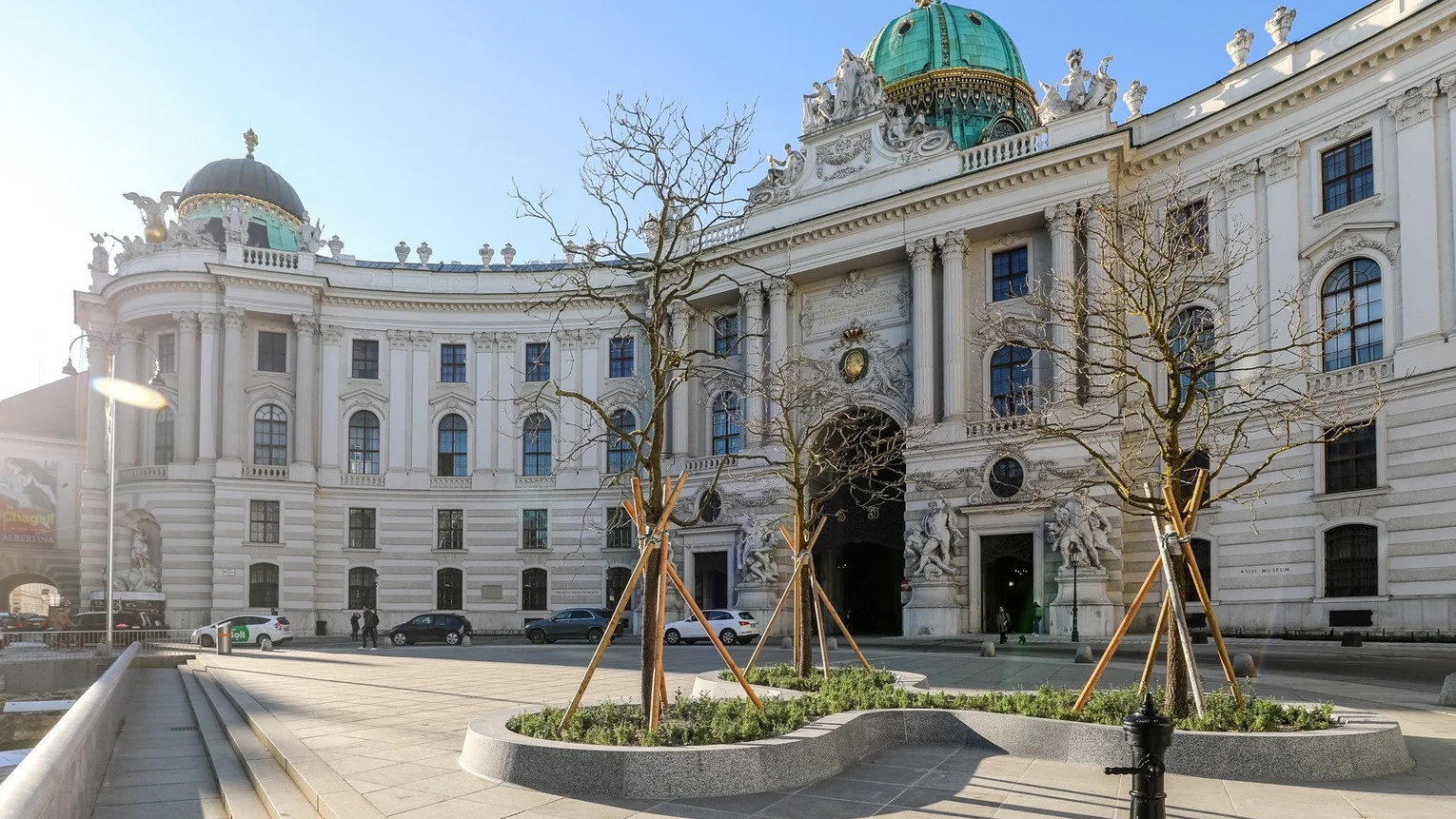
Historical and sustainable: Michaelerplatz

Infrastructure
During the redesign of Michaelerplatz, particular attention was paid to preserving its historical character in accordance with the preservation order. Conceived around 1725, the baroque Sternplatz was not realised until the end of the 19th century. The old Burgtheater once stood here. The first public gas lighting was installed here in 1838, Vienna's first roundabout in 1927 and the only one with clockwise traffic. Michaelerplatz is surrounded by the Hofburg, the Looshaus, St Michael's Church and Palais Herberstein. In the middle of the square are archaeological excavations, which have been uncovered since 1991 and were framed by the architect Hans Hollein. We focussed in particular on the preservation and restoration of this high-quality square design. From an urban planning perspective, the unobstructed visual axis from the Kohlmarkt to the Michaelertor with the Michaelerkuppel was very important. But there was much more to consider during the redesign.

Project name: Redesign of Michaelerplatz
Client: MA28
Contractor: Porr Bau GmbH Tiefbau NL Vienna
Architect/Planner: Office Katzberger
Type of contract: Unit price contract
Project type: Road construction (paving with granite slabs)
Scope of services: Redesign of a city centre square with granite slabs and road surface concrete
Order volume: EUR 2.7 million
Start of construction: 04/2024
End of construction: 11/2024
Location: 1010 Vienna, Michaelerplatz
New quality of life
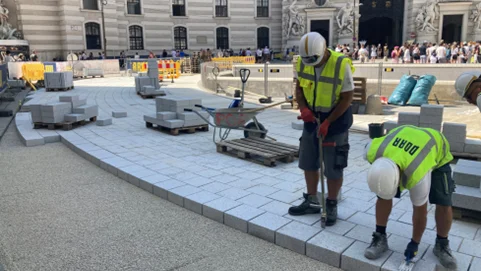
One of the main aims of the renovation work was to make Michaelerplatz more attractive for pedestrians. The existing pedestrian zone was extended from the Kohlmarkt side across the centre of the square to Reitschulgasse. This increased the length of Kohlmarkt and halved the area for motorised traffic on Michaelerplatz. The new light-coloured natural stone paving - 12 cm thick granite slabs - not only enhances the appearance of the square, but also allows rainwater to seep away. On the remaining traffic area, the bumpy paving stones have given way to a more resistant and even concrete surface, which benefits wheelchair users and cyclists. In addition, a number of seating areas now invite people to linger and relax. The new barrier-free surface has been supplemented with a tactile guidance system for blind and visually impaired people. There are also trees specially designed for the square. The rest of the area has become a meeting zone. Traffic is channelled through a one-way system from Herrengasse to Reitschulgasse. Only cyclists and taxis are exempt from the one-way system.
Historical challenge
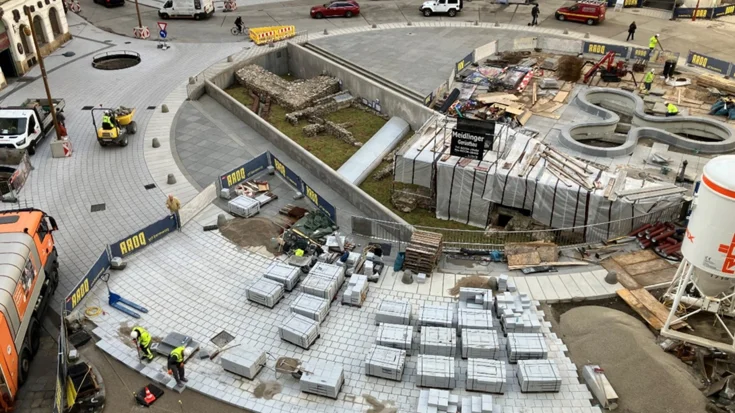
A special task for us was the construction of a tree surround in the area of the so-called archaeological field with the excavations. Around 2,000 years of settlement history were uncovered here in 1990 and 1991. In Roman times, part of the camp suburb - the so-called canabae legionis - where the legionary soldiers, traders and craftsmen lived was located on this very spot. There were inns, workshops and shops on Michaelerplatz. So there was always a lot going on in the centre of Vienna. The artefacts are open to the public and can be admired at any time. To ensure that they remain undamaged, we have developed a special construction for the new trees in the centre of the square - a reinforced concrete structure that is located above the old brick vault from Roman times.
Sustainable upgrading
Following completion of the renovation work, Michaelerplatz was officially opened by city councillor Ulli Sima, district councillor Markus Figl and Erhard Rauch, pastor of St Michael's Church. "We hope to have squared the circle and accommodated as many wishes as possible," said the city councillor. Now it is possible to cross the square by bike "without getting a concussion". The new groove-free surface in combination with a reduction in the number of hackney carriages - only four parking spaces remain - and precautions for the drainage of waste water also ensure that the previously pungent odour - especially in the summer months - is hardly noticeable today. In any case, after a few round tables and adaptations to the original plans, the critical voices have been silenced. We have preserved, redesigned and improved Michaelerplatz. And today, one year later, we can say that we have created a historically modern feel-good place in the middle of Vienna's city centre.