The Olympia Anchor: Innovative and sustainable

competencies
The roof of Munich’s Olympic Stadium has been a landmark of the Bavarian capital since the 1972 Games. Beneath the surface, 474 Stump Duplex anchors ensure that it remains securely in place. Developed by Stump, a subsidiary of our PORR Group, they may be invisible, but they are indispensable.
Olympic Games set against a natural backdrop with short distances between venues – this was the central idea when the team led by architect Günther Behnisch, together with Jürgen Joedicke, won the competition for the Olympic site in 1967. Instead of a monumental stadium like the one in Berlin, a masterpiece of architecture was created that blends harmoniously into the landscape. A major technical challenge was the construction of the 74,800 m² tent-like roof structure, spanning all three arenas, as a permanent structure. The structural engineering was undertaken by Frei Otto, a pioneer of lightweight construction. The team at Stump ensured safe, durable foundations. And they demonstrated how sustainable and resource-efficient construction can be achieved: with innovative, long-lasting solutions and the courage to break new ground. The Duplex anchor received the first general building regulatory approval in 1969. In doing so, Stump took on a pioneering role.
Constant Tension
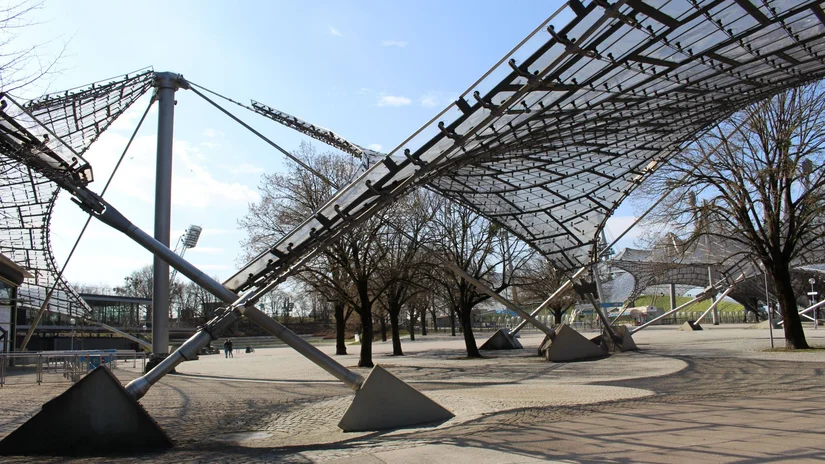
The two main challenges were achieving the precise curvature of the saddle-shaped membrane surfaces and ensuring the safe transfer of loads whilst maintaining a constant tensile stress throughout the entire cable-net structure. For the geometric calculation of the highly complex roof structure, a computer programme based on the finite element method (FEM) was used for the first time. In traditional tent roofs, the roof membrane extends all the way to the tops of the masts. At the Munich Olympic Stadium, the spatial truss structure absorbs the loads from the roof membrane and transfers them to the 440-metre-long main cable at the front edge of the roof. This cable transfers tensile forces of almost 50 MN to pylons up to 81 metres high behind the stadium. This design thus allows for an unobstructed view from the main stand, as the roof load does not need to be transferred via supports. One crucial question remained: how can the enormous tensile forces be permanently anchored in the ground?
Innovative Anchoring
The answer: In addition to heavy-duty foundations and grouted anchors, the Stump-Duplex permanent grouted anchor system was used. Their pressure-tube anchor, which was still a relatively new and innovative product at the time, was approved for the first time as a permanent solution – a decidedly bold decision. With this approval, Stump set new standards for quality, safety, corrosion protection and sustainability. Permanent anchors are more cost-effective and more resource-efficient than heavy-weight foundations. As the load-transfer path is kept under constant pressure, no tensile cracks can occur in the grouted body. At the same time, the tensile member is effectively protected against corrosion along its entire length – a crucial prerequisite for approval as a permanent anchor.
Heimliche Olympioniken
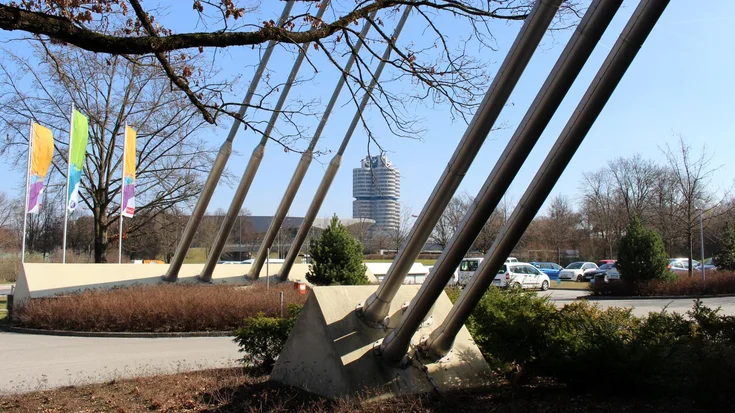
A total of 474 pressure pipe anchors, with a combined length of around 8,000 running metres, were installed across 38 foundations. Depending on the location and the load, the length of the individual anchors varied between 13 and 22 metres. Depending on the load, between eight and 26 anchors were installed per foundation. The load-bearing capacity of the individual foundations is impressive: depending on the design, they can safely withstand cable tensile forces of between around 2.84 and 9.31 MN. The permanent anchors proved to be technically sound and resource-efficient, as they enabled a significant amount of concrete to be saved. What’s more, even 50 years later, they remain reliable, thereby avoiding the need for refurbishment and the associated additional consumption of materials and energy. It is not just spectacular architecture that makes buildings unique. Often, it is the invisible and innovative solutions – such as the Olympia anchor – that make visions possible in the first place. And we are very proud of that.


