They all offer plenty of fresh air and natural light. And when it comes to sustainability, these educational buildings score top marks. It’s architecture that sets the standard.
Modern educational buildings are bright, welcoming and inspiring. They provide space for ideas and serve as open spaces for communication. Furthermore, innovative technologies, sustainable materials and efficient operation ensure that the buildings have the longest possible lifespan.
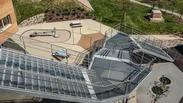
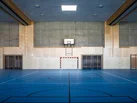
5. Educational campus on BerresgasseVienna, Austria
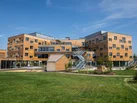
Everything from a single source: The Berresgasse Educational Campus in Hirschstetten, Vienna, was planned by the City of Vienna as a public-private partnership model and implemented between 2017 and 2019. PORR, together with pde and PORR Bau GmbH, was responsible for the financing, planning and construction of the project. All products used had to be durable, low-maintenance and hard-wearing. For this reason, during so-called sampling sessions, all key products were scrutinised, tested for suitability and, where necessary, replaced with alternative products. The campus now offers children up to the age of fourteen a holistic, inclusive educational facility comprising nursery groups, a kindergarten and schools. There is also a triple-purpose sports hall, a band rehearsal room and outdoor play and sports facilities.
Incidentally, the Aspern Central Vocational School is not yet completed but is highly innovative. The use of CO₂-reduced cement, data exchange with the digital twin during operation, and the deployment of AI-based building management systems make this new building an exciting major project in the education sector for the consortium comprising PORR and Apleona. Completion is scheduled for 2028. For those who’d like to take a peek behind the construction fence now: by the end of 2025, we’ll have transformed the construction site into a stage for a dancer. You can find the article and video here.
4. École DucasseParis, France
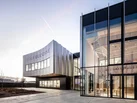
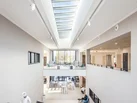
In the suburb of Meudon-la-Fôret, 10 km south-west of Paris, a new culinary training centre has been in operation since 2020: the École Ducasse. Spanning 5,000 m², the site features thoughtfully designed kitchens, workshops, classrooms and a restaurant open to the public. Inside, the building is divided into four units. These represent the elements of earth, water, fire and air, and converge around a fifth element: emptiness, as the central space. A solid, dark concrete foundation is intended to radiate durability and stability. The upper floor is clad in a sculpted metal skin, interrupted by generous, curved glass façades. The building was designed by Arte Charpentier Architectes.

3. Bloomingdale International SchoolVijayawada, India
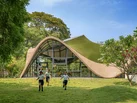
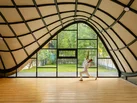
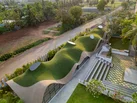
The Bloomingdale International School in Vijayawada is the only international school in the state of Andhra Pradesh, India. The extension to the nursery school, designed by AndBlack Design Studio, aims to merge the built form, landscape and interiors into a single cohesive whole. An unconventional spatial layout, modern technologies and robust, sustainable materials characterise the new building. Instead of small, rectangular, dark classrooms, the architects have planned fluid, interconnected spaces that encourage free movement and interaction. Rather than relying on the typically bright colours associated with pre-school children, the design focuses on form, which is intended to convey a sense of playfulness through the building’s architecture. The undulating, green roof with glass inserts and large glass panels in the façade allow the outdoors and indoors to merge. The building was completed in 2024, and the green roofs have already made the school a landmark in the area.
2. Herta Mohr Building Leiden, Netherlands
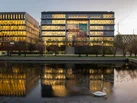
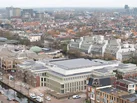
The renovation and extension of the former Cluster Zuid building of the Faculty of Humanities at Leiden University, the Netherlands, was completed in 2024 and reopened as the Herta Mohr Building. Since then, it has offered more than 700 teaching rooms, two large lecture theatres and spacious communal areas across a total floor area of 11,400 m². The architectural firm De Zwarte Hond has merged several individual buildings, which originally contained dark, cramped rooms, into a modern, light-filled educational building. In the new upper-floor extension, façade elements and components from the demolition – such as the striking concrete columns – were reused. The old ceiling panels made of Sequoia redwood have also been given a new lease of life as wall cladding in the atrium. This has enabled the listed structure from the 1970s in the basement to be preserved, whilst numerous elements of the old upper floor have been optimally integrated into the new superstructure. Insulation, solar panels and the heat/cold storage system are state-of-the-art. The BREEAM Excellent certification underscores that modern technologies, sustainability and heritage conservation can work together perfectly – a top-class educational building that embodies intelligent use of space and the circular economy.


1. Langeveld BuildingRotterdam, Netherlands
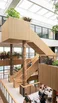
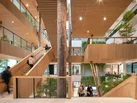
The Langeveld Building on the Erasmus University Rotterdam campus, with a BREEAM score of 91.5%, is a flagship project in modern educational architecture. It was completed in 2023. With plenty of light, generous green spaces and flexible usage options, it serves as a retreat, a learning oasis and a space for communication. The team at Paul de Ruiter Architects based their design on circular principles and biophilic design. Consequently, many components are made from recycled, bio-based and reused materials sourced from the university’s demolition projects. Across a floor area of 8,748 m², abundant greenery ensures a pleasant climate. Indoor planters, whose vegetation can grow outwards, not only attract native insects, but birds also build their nests amongst the foliage. The greenery also benefits the innovative Powered by Nature ventilation system: modelled on termite mounds, the rooms are naturally ventilated using the power of the sun and wind. According to the architectural firm, this system reduces energy consumption for air conditioning by a whopping 85%. Overall, the new building is a top-class educational facility that deserves to be called a pioneer – just like its namesake: Prof. Henny Langeveld (1926–2004), the first female professor at Erasmus University Rotterdam.